

Colombia passes landmark bill to end female genital mutilation

Juliana Domicó, Councillor of the Confederation of the Peoples of the Great Emberá Nation. Photo credit Equality Now
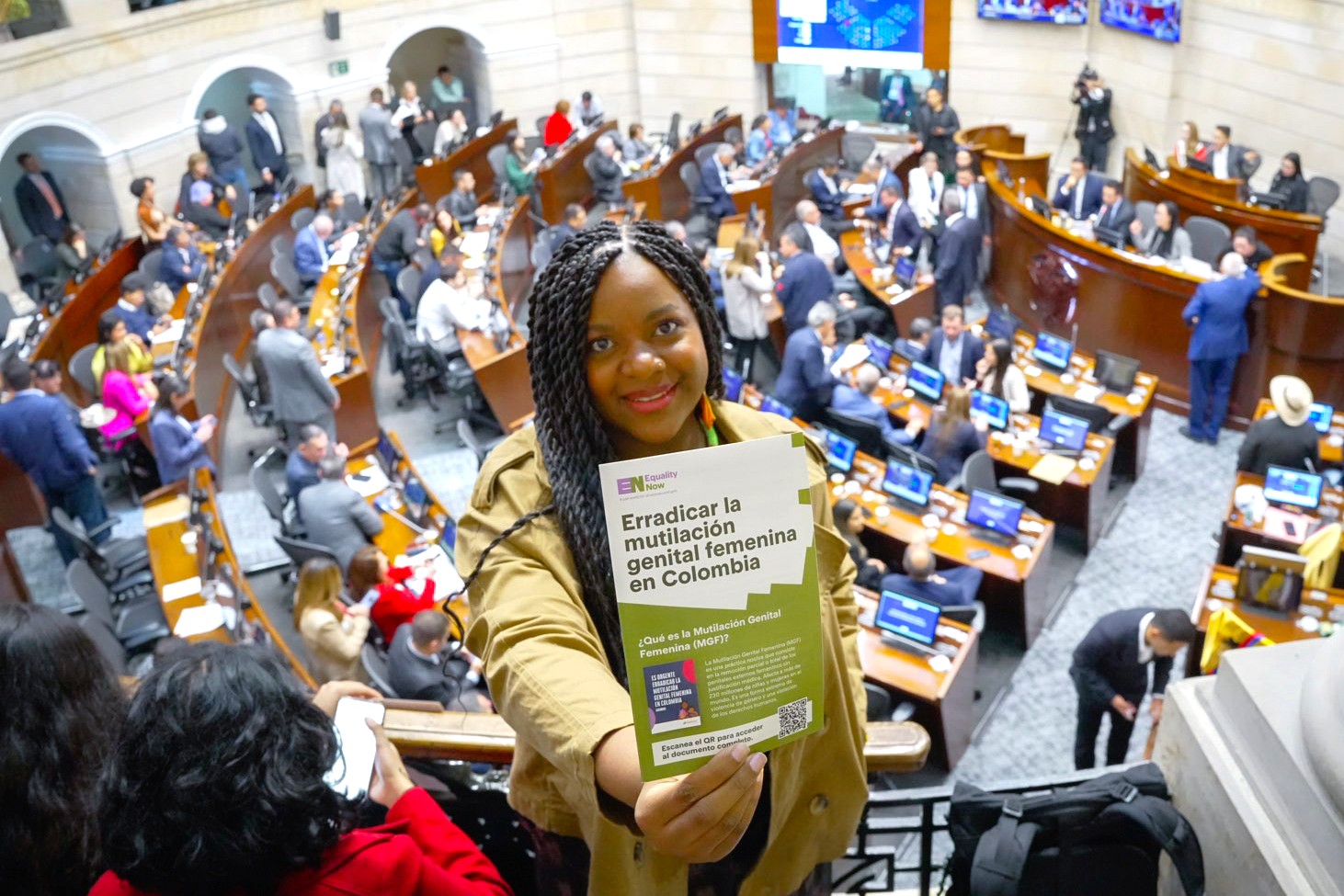
Leandra Becerra, Legal and Advocacy Advisor for Equality Now, at Colombia's House of Representatives. Photo credit Equality Now
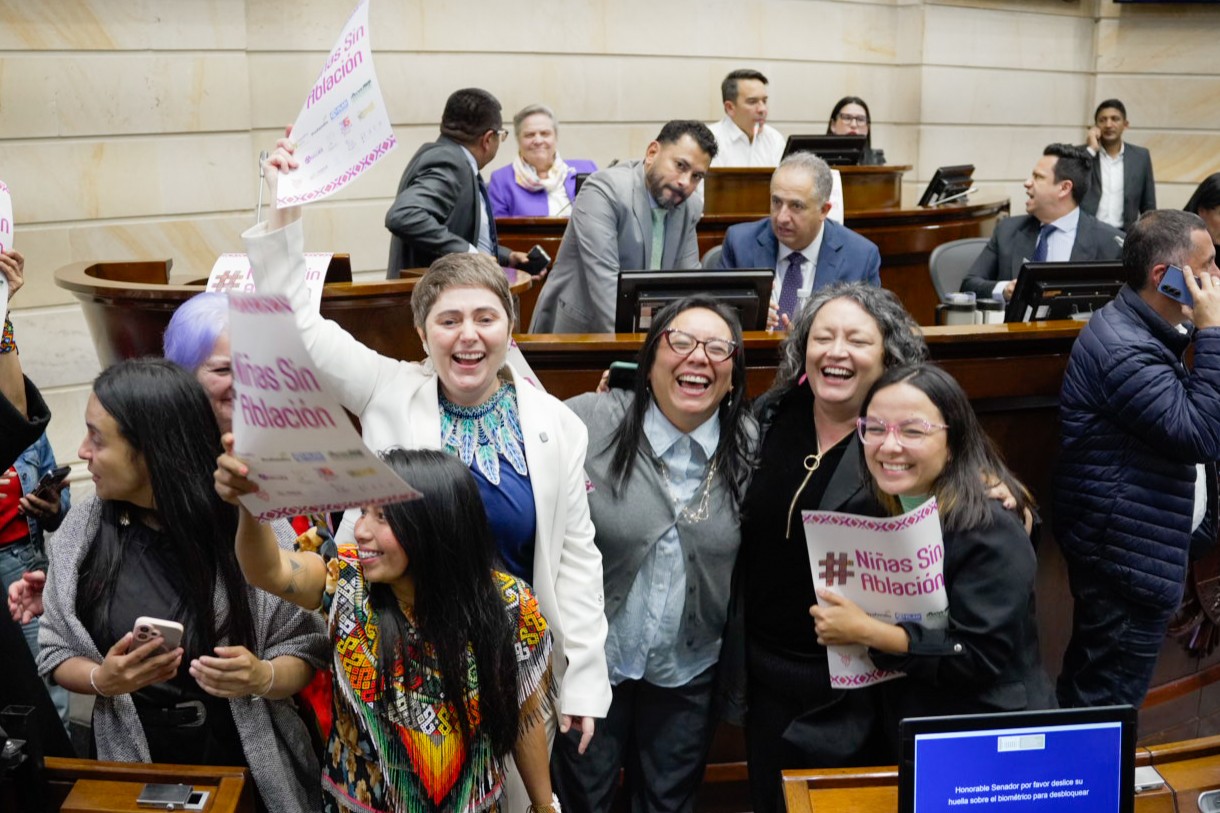
Jenifer Pedraza, Angélica Lozano, Alexandra Vasquez, authors of the bill Carolina Giraldo, and Claudia Queragama, celebrate the passing of Proyecto de Ley No. 440 de 2025 Senado-018 de 2024 Cámara. Photo credit Equality Now
Colombia has become the first Latin American country to prohibit FGM, with Indigenous women leading the campaign to protect girls from this harmful practice.
In doing so, Colombia has taken a regional lead by becoming the first Latin American country to adopt legislation specifically focused on FGM.
Internationally recognised as a serious human rights violation and form of gender-based violence, FGM affects over 230 million girls and women worldwide, including in the Americas. In Colombia, it has been primarily identified within Indigenous communities and isolated cases have also been documented among Afro-Colombian and migrant communities.
Between 2020 and 2025, Colombia recorded 204 FGM cases nationwide, 177 of them involving Indigenous girls, mainly in the departments of Risaralda and Chocó. Experts warn that these figures significantly underestimate the true prevalence due to persistent underreporting.
The passing of Bill 440, otherwise known as Proyecto de Ley No. 440 de 2025 Senado-018 de 2024 Cámara, is historic, partly because of who drove it forward: Indigenous women. Their active participation and tireless activism brought visibility to a previously hidden practice and ensured that the State's response to FGM has incorporated an intercultural approach that respects the rights and realities of affected communities.
Equality Now supported this process by providing technical assistance to Congress and other State actors on international standards and FGM laws in other countries and worked to ensure that Indigenous women and civil society organisations had a meaningful role in shaping the legislation.
IMPLEMENTING COLOMBIA’S NEW LAW TO END FGM
Following Congress’s approval, President Gustavo Petro must sign Bill 440 into law to formally enact it.
The legislation clearly outlines the State’s responsibilities to prevent FGM. Key provisions include the creation of a national policy for the prevention, care, and eradication of FGM and the introduction of mandatory healthcare protocols with training for personnel to identify and respond to cases. It also requires the strengthening of information systems to ensure the regular collection and publication of data on the practice.
Effective implementation will require sustained awareness-raising and capacity-building across government institutions, communities, and civil society, underpinned by adequate resourcing. Above all, it will depend on close coordination with affected communities to prevent FGM and support survivors, alongside a firm commitment from all institutions responsible for enforcement.
Although FGM in Colombia has been found primarily amongst some Indigenous communities, portraying it as an exclusively ethnic issue is inaccurate and risks reinforcing stigma. International evidence compiled by Equality Now illustrates how FGM occurs across diverse cultural, religious, and geographic contexts, including migrant communities and other settings where discriminatory gender norms persist.
WHAT IS FEMALE GENITAL MUTILATION, AND WHAT ARE ITS CONSEQUENCES?
FGM, also known in Colombia as ablación, includes all procedures involving the partial or total removal of the external female genitalia or other injuries to female genital organs for non-medical reasons.
According to the World Health Organization (WHO), FGM can cause a range of serious health issues, including haemorrhage, infections, chronic pain, complications during childbirth, mental distress, and even death. The practice is deeply rooted in beliefs aimed at controlling the sexuality and bodies of girls and women.
In 2012, the UN General Assembly unanimously adopted a resolution calling for the elimination of FGM, and Sustainable Development Goal 5.3 calls for the elimination of FGM by 2030.
FGM AROUND THE WORLD
Equality Now’s report, ‘The time is now: End female genital mutilation/cutting, an urgent need for global response,’ identified how only 59 of the 94 countries where FGM has been documented have laws specifically addressing it, and these are primarily concentrated in Africa, Europe, and North America.
Global experience shows that ending FGM requires a combination of strong legal frameworks, coordinated implementation, and community engagement.
Countries such as Kenya have paired legislation with dedicated coordination bodies and community-led commitments. Indonesia has addressed FGM from a health and sexual and reproductive rights perspective, while France has prioritised prevention through education, and in Uganda and Somalia, protections are embedded at the constitutional level.
By fully approving Bill 440, Colombia has added to the global momentum to end FGM globally and has set a strong regional precedent for other Latin American countries to take similar action.
In 2026, the Inter-American Commission on Human Rights (IACHR) reiterated that countries across the Americas must adopt urgent measures to eradicate FGM, recognising it as a violation of fundamental rights to personal integrity, health, and a life with dignity. This statement followed the Commission’s first-ever thematic hearing on FGM in the Americas, held in November 2025.
Leandra Becerra, Legal and Advocacy Advisor for Equality Now in Latin America and the Caribbean, concludes, “By voting to pass Bill 440 of 2025 in this fourth and final Senate debate, Colombia’s Congress is honouring its commitment to protect and guarantee the rights of girls and women.
"This achievement is the culmination of years of coordinated work by survivors, women’s rights activists, and lawmakers, who have collaborated to bring this issue to light and build understanding about the urgent need for legislation to help end FGM. The challenge now is to ensure the law is effectively implemented through sustained political will and adequate resources so that no girl in Colombia is ever subjected to FGM again.”
*********************************************************
About: Equality Now is a worldwide human rights organisation dedicated to securing the legal and systemic change needed to end discrimination against all women and girls. Since its inception in 1992, it has played a role in reforming 120 discriminatory laws globally, positively impacting the lives of hundreds of millions of women and girls, their communities and nations, both now and for generations to come.
Working with partners at national, regional and global levels, Equality Now draws on deep legal expertise and a diverse range of social, political and cultural perspectives to continue to lead the way in steering, shaping and driving the change needed to achieve enduring gender equality, to the benefit of all.
For more information on FGM, see ‘The time is now: End female genital mutilation/cutting, an urgent need for global response'
https://equalitynow.org/resource/reports/the-time-is-now-end-female-genital-mutilation-cutting-an-urgent-need-for-global-response-2025-update/
Tamara Rusansky
Equality Now
trusansky@equalitynow.org
Visit us on social media:
LinkedIn
Bluesky
Instagram
Facebook
YouTube
Legal Disclaimer:
EIN Presswire provides this news content "as is" without warranty of any kind. We do not accept any responsibility or liability for the accuracy, content, images, videos, licenses, completeness, legality, or reliability of the information contained in this article. If you have any complaints or copyright issues related to this article, kindly contact the author above.
