

What Engineers Need from an Advanced Industrial Humidity Control Service Provider: Dryair's Sensors and PLC Control
News originally published by
EIN Presswire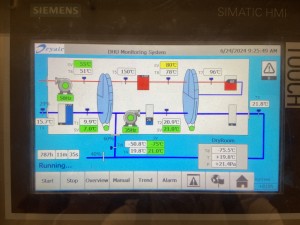
What Should the Control System Measure?
In precision humidity control, multi-loop automation relies on real-time sensory feedback from both the treated process air and the regeneration exhaust stream to decouple temperature regulation from moisture adsorption. An automated humidity control system is only as effective as the sensory feedback it receives. Relying on a single wall-mounted sensor to represent a large, partitioned manufacturing suite introduces severe blind spots, as machinery heat, personnel movement, and door openings create localized microclimates.
A comprehensive industrial instrumentation plan should monitor:
Supply-Air Conditions: Dry-bulb temperature and dew point measured immediately downstream of the post-cooling coil, verifying that air delivered to the ductwork meets baseline process criteria.
Room Environmental Conditions: Temperature and relative humidity (or dew point) monitored across multiple operational zones, particularly adjacent to sensitive assembly or packaging lines.
Return-Air State: Temperature and moisture content of mixed return air, providing the control algorithm with an accurate measurement of the cumulative internal room load.
Reactivation Air Stream: Reactivation inlet and exhaust temperatures, ensuring that the desiccant wheel receives sufficient thermal energy for complete moisture desorption.
Differential Pressures: Static pressure drop across primary, secondary, and HEPA filter banks, signaling maintenance requirements before airflow declines.
Engineers must define these measurement points, expected operating ranges, and sensor locations during the design phase to ensure the control system receives representative process data.
What Does the PLC Need to Control?
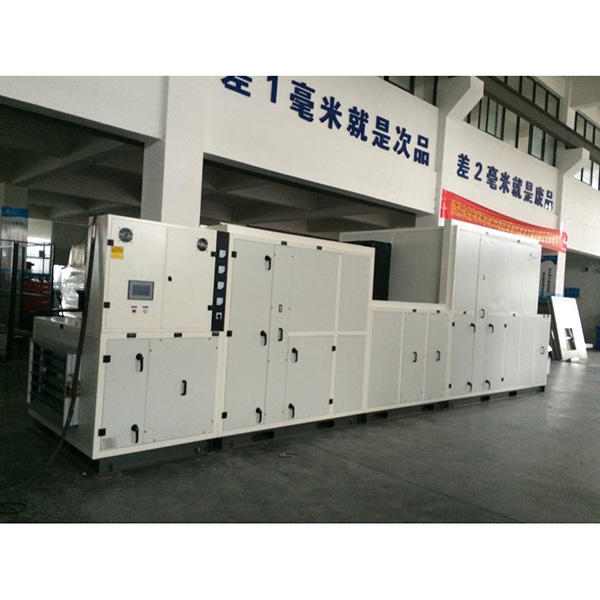
In Dryair's turnkey dry-room installations, central automation uses a Siemens S7-200 SMART (or S7-1200) PLC with a matching touchscreen HMI. The ZCB combined desiccant dehumidifier series also offers configurable PLC-based temperature and humidity control.
The primary responsibility of the PLC is coordinating the distinct actuators that govern thermal and moisture-removal processes:
Reactivation Energy Modulation: Modulating electric heating elements (via SCR power controllers) or steam control valves to maintain optimal desiccant desorption temperatures while minimizing energy waste.
Cooling Coil Valve Regulation: Modulating chilled-water two-way or three-way control valves (or staging DX refrigeration compressors) on pre-cooling and post-cooling coils to achieve precise dry-bulb setpoints.
Fan Speed and Static Pressure: Regulating variable frequency drives (VFDs) on process supply fans to maintain required duct static pressure and air change rates.
System Interlocks: Enforcing strict safety logic, such as preventing reactivation heater operation unless the reactivation fan and rotor drive motor are running and airflow is confirmed.
By centralizing these control loops, the PLC prevents the dehumidifier, cooling system, and fans from operating in conflict.
How Should Reactivation and Cooling Loops Interact?
Reactivation heating and process cooling represent opposing thermodynamic forces within the dehumidifier cabinet. Reactivation introduces intense heat (typically 60°C to 130°C depending on whether waste-heat or conventional thermal regeneration is employed) to desorb moisture from the rotor matrix. Conversely, pre-cooling and post-cooling coils extract sensible heat from the process air stream.
A sophisticated control sequence must decouple and coordinate these two loops. When room moisture loads spike, the PLC increases reactivation energy to enhance rotor adsorption capacity. However, because higher reactivation temperatures transfer residual heat into the process sector of the rotor, the control algorithm must feedforward a corresponding adjustment to the post-cooling control valve. Without this coordinated control, increasing dehumidification capacity would cause unintended supply-air temperature spikes, destabilizing the production environment.
What Should Operators Be Able to See and Adjust?
The human-machine interface (HMI) serves as the operational window into the environmental control system. Dryair's turnkey architecture utilizes a central industrial touchscreen that provides clear visualization of operating parameters, equipment statuses, and system alarms.
The HMI software is designed to be modifiable and expandable, allowing facility managers to integrate additional ZCH or ZCB systems as manufacturing footprints expand. A well-engineered interface should provide:
Real-time display of supply, return, room, and reactivation temperatures and dew points.
Dynamic equipment status indicators for fans, rotor drives, heaters, and cooling valves.
Password-protected access levels distinguishing routine operator adjustments from engineering configuration menus.
Real-time and historical trend logging for temperature, humidity, and dew point compliance auditing.
Multi-tier alarm management, categorizing warnings (e.g., filter loading) from critical shutdowns (e.g., high reactivation temperature or fan failure).
Which Sensor and Network Requirements Belong in the RFQ?
When preparing a Request for Quotation (RFQ), engineering teams should explicitly state their instrumentation and networking standards rather than assuming standard catalog items will suffice. Specifications should detail:
Sensor measurement principles (e.g., thin-film polymer, chilled mirror, or capacitive transmitters) and required calibration tolerances.
Environmental protection ratings (e.g., IP65 or NEMA 4X) for sensors exposed to washdown or corrosive atmospheres.
Sensor redundancy requirements for critical manufacturing zones where sensor drift could spoil product batches.
Preferred PLC hardware platforms and preferred communication protocols (such as Modbus TCP/IP, BACnet/IP, or Profinet) for integration into the central Building Management System (BMS) or SCADA network.
Data retention, historian export formats, and cybersecurity access restrictions.
Providing these requirements in the RFQ ensures that the service provider prices and delivers a control system fully compliant with plant automation standards.
What Control Documents Should Be Part of the Engineering Package?
A professional controls package requires comprehensive engineering documentation to facilitate commissioning, validation, and maintenance. Before equipment delivery, the service provider should submit:
Control Narrative: A detailed functional description of all operating sequences, including startup, steady-state regulation, seasonal modes, alarms, and emergency shutdowns.
I/O Schedule: A complete list of all digital inputs, digital outputs, analog inputs, and analog outputs, detailing signal types and device tags.
Instrument Schedule: Complete specifications for all sensors, transmitters, control valves, and actuators, including manufacturer, model, range, and accuracy ratings.
Electrical Schematics: Comprehensive control panel wiring diagrams, single-line power diagrams, and terminal strip layouts.
Cause-and-Effect Matrix: A structured table detailing system responses to equipment trips, power losses, and safety interlock triggers.
Choose the Provider Around Control Responsibilities, Not the PLC Name Alone
Selecting an industrial humidity control partner should not be reduced to checking whether a specific PLC brand appears on a cut sheet. The decisive criteria are whether the provider understands multi-loop thermodynamic control, how effectively the automation coordinates desiccant adsorption with sensible cooling, and whether the architecture can scale alongside facility growth.
This integrated automation capability is substantiated by demanding industrial applications. In an advanced manufacturing project for Fergrove Pharmaceutical, Dryair integrated a centralized Siemens S7-200 control architecture with modulated steam reactivation valves and multi-point humidity transmitters. The system automatically balanced seasonal moisture fluctuations to maintain tight environmental setpoints (T ≤ 20°C, RH ≤ 15%) across continuous 24/7 production shifts.
Dryair combines proven desiccant engineering with expandable Siemens S7-200 central touchscreen automation, delivering the control precision required for advanced manufacturing. To discuss control specifications or request an engineering consultation, visit the Dryair official website.
Dryair
Dryair
Legal Disclaimer:
EIN Presswire provides this news content "as is" without warranty of any kind. We do not accept any responsibility or liability for the accuracy, content, images, videos, licenses, completeness, legality, or reliability of the information contained in this article. If you have any complaints or copyright issues related to this article, kindly contact the author above.
