

Renewable Muconic Acid Market Expected valuation at SD 42 million in 2026 | Fact.MR Report
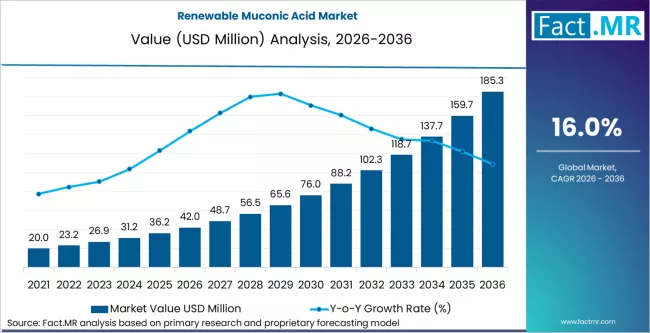
In 2025, the renewable muconic acid market was valued at USD 36 million, demand for renewable muconic acid is estimated to reach USD 42 million in 2026
ROCKVILLE, MD, UNITED STATES, February 24, 2026 /EINPresswire.com/ -- The global renewable muconic acid market is projected to grow from USD 62.4 million in 2026 to approximately USD 138.3 million by 2036. This represents a strong compound annual growth rate (CAGR) of 8.3% over the ten-year forecast period.The market is being driven by the shift toward bio-based platform chemicals and the rising demand for sustainable precursors in the production of PET plastics, nylon, and polyurethane.
Get Access of Report Sample: https://www.factmr.com/connectus/sample?flag=S&rep_id=14342
Quick Stats:
Market size 2026? USD 62.4 million.
Market size 2036? USD 138.3 million.
CAGR? 8.3% (2026–2036).
Leading derivative segment? Adipic Acid (produced from muconic acid) leads the market with a 48.0% share.
Leading application? Plastics and Textiles (nylon and PET production) are the primary demand drivers.
Key growth regions? North America (largest share), Europe, and Asia-Pacific (fastest growing).
Top companies? Myriant Corporation, Amyris, Inc., DynaMotiv Energy Systems, Sarom Global, and various biotech research firms focused on metabolic engineering.
Market Momentum (YoY Path)
The renewable muconic acid market is moving from pilot-scale fermentation to commercial-level industrial application. Valued at USD 62.4 million in 2026, the market is expected to reach USD 79.5 million by 2029. As the automotive and apparel industries accelerate their transition away from petroleum-derived polymers, the valuation is projected to hit USD 106.8 million by 2032, eventually arriving at USD 138.3 million by 2036.
Why the Market is Growing
Growth is primarily fueled by the "Decarbonization of the Chemical Value Chain" and the "Bio-based PET Revolution." Muconic acid is a versatile dicarboxylic acid that can be easily converted into adipic acid (for Nylon 6,6) or terephthalic acid (for PET). Traditionally, these chemicals are derived from benzene, a petroleum-based carcinogen. Renewable muconic acid, produced via the fermentation of plant-derived sugars or lignin by engineered microorganisms (like E. coli or yeast), offers a "drop-in" sustainable alternative. As global brands like Coca-Cola and Adidas push for 100% bio-based packaging and textiles, the demand for renewable intermediates like muconic acid is surging.
Segment Spotlight
1. Derivative: Adipic Acid vs. Caprolactam
Adipic Acid is the dominant derivative. By hydrogenating renewable muconic acid, manufacturers can produce bio-adipic acid, which is essential for the automotive parts and footwear industries. Caprolactam and Terephthalic Acid are smaller but rapidly growing segments, targeting the high-performance fiber and bottle-grade plastic markets.
2. Source: Sugar vs. Lignin-based
While glucose and sucrose remain the primary feedstocks for fermentation, lignin-based muconic acid is the fastest-growing sub-segment. Utilizing lignin—a byproduct of the pulp and paper industry—allows manufacturers to produce muconic acid without competing with food crops, significantly improving the sustainability profile of the end product.
3. Regional Focus: North American Innovation
North America holds the leading market share due to a concentration of biotech startups and significant government grants for bio-refinery infrastructure. Asia-Pacific is the fastest-growing region (9.2% CAGR), driven by massive textile manufacturing hubs in China and India that are facing increasing pressure to adopt "Green Chemistry" standards.
Drivers, Opportunities, Trends, and Challenges
Drivers:
Key catalysts include stringent regulations on VOC emissions from traditional chemical plants, the volatility of crude oil prices, and the superior purity levels achieved through advanced fermentation processes.
Opportunities:
There is a significant opportunity in High-performance Resins and Coatings. Muconic acid contains double bonds that make it ideal for creating specialized unsaturated polyester resins (UPRs) used in marine and construction applications, offering better UV resistance and thermal stability than traditional resins.
Trends:
A major trend is the use of CRISPR-Cas9 for Strain Optimization. Research is focused on engineering "super-yeasts" that can tolerate high concentrations of muconic acid during fermentation, which dramatically increases yield and lowers production costs. Another trend is the "Circular Bio-economy," where muconic acid is produced from agricultural waste.
Challenges:
The market faces hurdles from Scale-up Costs. Bio-based muconic acid currently remains more expensive to produce than petroleum-based adipic acid. Additionally, the Downstream Processing (DSP)—the energy-intensive step of separating the acid from the fermentation broth—remains a technical bottleneck that impacts overall profitability.
Country Growth Outlook (CAGR 2026-2036)
China 9.5%
India 9.1%
USA 8.2%
Brazil 7.8%
Germany 7.4%
Competitive Landscape
The market is characterized by a mix of Specialty Biotech Firms and Strategic Partnerships with large chemical conglomerates. Companies like Myriant and Amyris lead in intellectual property and strain development. Competition is focused on "Yield Breakthroughs"—the first company to achieve a production cost comparable to petroleum-based benzene will likely capture the majority of the massive adipic acid market.
Browse Full Report: https://www.factmr.com/report/renewable-muconic-acid-market
Purchase Full Report for Detailed Insights
For access to full forecasts, regional breakouts, company share analysis, and emerging trend assessments, you can purchase the complete report here: https://www.factmr.com/checkout/14342
Have a specific Requirements and Need Assistant on Report Pricing or Limited Budget please contact us – sales@factmr.com
To View Related Report :
Renewable Heating Fuels Market: https://www.factmr.com/report/renewable-heating-fuels-market
Renewable-Energy Powered PVC Resin Production Platforms Market: https://www.factmr.com/report/renewable-energy-powered-pvc-resin-production-platforms-market
Renewable Methanol Market: https://www.factmr.com/report/renewable-methanol-market
Renewable Chemicals Market: https://www.factmr.com/report/renewable-chemicals-market
S. N. Jha
Fact.MR
+1 628-251-1583
email us here
Legal Disclaimer:
EIN Presswire provides this news content "as is" without warranty of any kind. We do not accept any responsibility or liability for the accuracy, content, images, videos, licenses, completeness, legality, or reliability of the information contained in this article. If you have any complaints or copyright issues related to this article, kindly contact the author above.
