

Colombia’s Senate urged to pass bill on female genital mutilation before legislative deadline
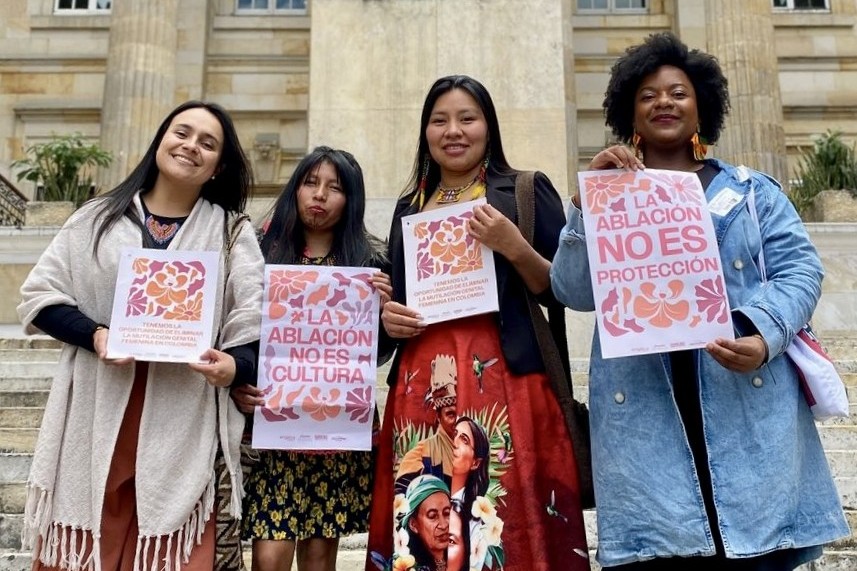
Women's rights advocates in Colombia urge lawmakers to pass bill addressing FGM, Photo credit: Equality Now

With Colombia’s current legislative session drawing to a close, women’s rights advocates urge lawmakers to approve a bill to protect girls from FGM.
If the deadline is missed, the bill will expire, forcing the entire legislative process to begin again from scratch, with no guarantee that a new FGM bill would be reintroduced or prioritised again.
Ahead of the International Day of Zero Tolerance for Female Genital Mutilation on February 6th, women’s rights advocates are calling on senators to vote and approve the bill before the current legislative deadline.
“Colombia stands at a defining moment,” explains Leandra Becerra from Equality Now. “The FGM bill before the Senate offers lawmakers a historic chance to close a longstanding legal vacuum. Indigenous women leaders and advocates have been campaigning for years to reach this point and significant progress has already been achieved. Passing this legislation would transform political will into meaningful legal protection against FGM.
"But if the FGM bill is allowed to lapse due to inaction during this legislative session, a critical opportunity will be lost, and the legal process will have to begin again, with further delays exposing girls to continued risk from preventable harm."
FGM PERSISTS IN COLOMBIA AND LEGAL PROTECTION IS URGENTLY NEEDED
UNICEF estimates that FGM affects over 230 million women and girls worldwide. It is internationally recognised as a serious human rights violation involving the partial or complete removal of external female genitalia for non-medical reasons. The practice is associated with severe and lifelong physical and psychological issues, and is rooted in gender inequality and attempts to control women’s and girls’ bodies and sexuality.
A 2025 report by Equality Now and its partners collated evidence of FGM in 94 countries. This includes Colombia, where the practice has been primarily identified within Indigenous Emberá communities, including the Emberá Chamí. Official government records also have isolated cases among Afro-Colombian and migrant communities.
Government health data shows that FGM disproportionately affects Indigenous girls in Colombia. Between 2020 and 2025, 204 cases were documented nationwide, 177 of them involving Indigenous girls, mainly in the departments of Risaralda and Chocó. Experts warn that such figures significantly underestimate the real prevalence due to persistent underreporting of FGM. Without accurate data, assessing the extent of the problem and designing appropriate responses is challenging.
A BILL TO ESTABLISH COLOMBIA’S FIRST LEGAL FRAMEWORK ON FGM
The absence of a specific law on FGM has left Colombia without a clear legal framework, hindering coordinated institutional responses, limiting prevention efforts, and weakening protection for girls at risk.
Proyecto de Ley No. 440 de 2025 Senado addresses these gaps by establishing clear State responsibilities for prevention, coordinated public policy, data collection, and protection. Translating this into meaningful action will require sufficient and sustainable resources, including for awareness-raising and capacity-building for government institutions, communities, and civil society, and underpinned by firm commitment from all institutions responsible for implementation.
Importantly, the bill recognises the central role of Indigenous women leaders in shaping effective solutions. It adopts a non-punitive approach, prioritising prevention, education, and culturally appropriate strategies, and promoting dialogue with affected communities.
Francia Elena Giraldo Guasorna, an Embera Chamí leader from Risaralda, is supporting the FGM bill and stated, “I decided to speak out after a girl died because of this practice. That is when I knew this could not continue. Approving this law is essential to protect girls and prevent more deaths.”
MOMENTUM BUILDS FOR LEGISLATIVE ACTION AGAINST FGM IN COLOMBIA
This legislative process is occurring as FGM is gaining greater visibility at the regional level. In November 2025, the Inter-American Commission on Human Rights (IACHR) held its first public hearing on FGM in the Americas and formally recognized it as an urgent regional human rights concern. The hearing included testimonies from survivors, Indigenous leaders, and medical and legal experts and increased regional attention on the obligation of governments to take urgent, coordinated action to prevent, address, and eradicate FGM.
Speaking during the IACHR hearing, forensic expert Dr Leonardo Quintero Suárez warned, “Colombia has made important advances in recognising this practice, but the lack of a robust legal framework limits effective prevention and follow-up… Legislative action is essential to move from isolated efforts to a coordinated State response.”
Leandra Becerra concludes, “Colombia has already recognised that female genital mutilation exists and causes harm. The question now is whether the Senate will act on that recognition, or allow the legislative process to collapse, with real consequences for girls.”
******************************************************************
Equality Now is a worldwide human rights organisation dedicated to securing the legal and systemic change needed to end discrimination against all women and girls. Since its inception in 1992, it has played a role in reforming 120 discriminatory laws globally, positively impacting the lives of hundreds of millions of women and girls, their communities and nations, both now and for generations to come.
Working with partners at national, regional and global levels, Equality Now draws on deep legal expertise and a diverse range of social, political and cultural perspectives to continue to lead the way in steering, shaping and driving the change needed to achieve enduring gender equality, to the benefit of all.
Tamara Rusansky
Equality Now
+55 21 99966-3828
trusansky@equalitynow.org
Visit us on social media:
LinkedIn
Bluesky
Instagram
Facebook
YouTube
Legal Disclaimer:
EIN Presswire provides this news content "as is" without warranty of any kind. We do not accept any responsibility or liability for the accuracy, content, images, videos, licenses, completeness, legality, or reliability of the information contained in this article. If you have any complaints or copyright issues related to this article, kindly contact the author above.
